
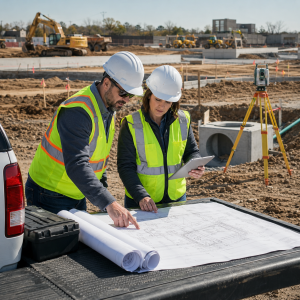
 A project can look deceptively simple when viewed from the outside. A site is selected, a concept is approved, construction begins, and eventually a finished building, roadway, or development takes shape.
What is easy to miss is everything that had to happen before the first crew arrived. Long before equipment moves onto a site, engineers study conditions, test assumptions, coordinate with other disciplines, and identify the decisions that will shape the entire project.
At McNeil Engineering, we see the preconstruction phase as one of the most valuable opportunities in the life of a project. It is the point when teams still have the flexibility to solve problems efficiently, compare options thoughtfully, and establish a clear path forward before changes become expensive.
A Better Project Starts With Better Questions
The earliest phase of engineering is less about producing immediate answers and more about asking the right questions. How will water move across the site? Where will utilities connect? What access limitations exist, and how might future growth affect the design?
These questions help uncover the real conditions behind a concept. A plan may appear workable at first glance, but closer analysis can reveal grading challenges, utility conflicts, circulation concerns, or permitting issues that should be addressed before the design advances.
Existing Conditions Set the Rules
Every site has a history, even when it looks like an empty piece of land. Elevation changes, soil characteristics, drainage patterns, surrounding development, easements, and existing utilities all influence what can be built and how it should be designed.
Ignoring those realities does not make them disappear. Early surveying and site analysis allow the engineering team to work with the property instead of forcing a concept onto conditions that may not support it.
That understanding can lead to more efficient grading, better infrastructure placement, fewer construction conflicts, and a design that performs more naturally over time. It can also help clients evaluate whether the original concept should be refined before major resources are committed.
Early Coordination Keeps the Pieces Connected
Modern projects involve far more than one plan set or one discipline. Civil engineers, structural engineers, surveyors, landscape architects, architects, contractors, utility providers, public agencies, and owners may all influence the final outcome.
When each group works in isolation, conflicts often appear late. A utility route may interfere with a structural element, a grading decision may affect accessibility, or a landscape feature may compete with drainage infrastructure.
Early coordination gives the team time to resolve those intersections while the design is still flexible. It also creates shared expectations, reduces duplication, and helps everyone understand how individual decisions affect the project as a whole.
Preconstruction Engineering Protects the Budget
Unexpected costs are often blamed on construction, but many begin much earlier. Incomplete site information, unverified utility locations, unclear permitting requirements, or poorly coordinated plans can all create change orders once work is underway.
Engineering before construction helps turn uncertainty into information. The more a team knows about the site, the regulatory environment, and the likely constraints, the more realistic the project budget can become.
This does not mean every surprise can be eliminated. It means the team can reduce avoidable uncertainty and make decisions while multiple options are still available, rather than after crews and equipment are already waiting in the field.
Permitting Is Easier When It Is Part of the Plan
Permitting should not be treated as a final administrative step. Local requirements, review timelines, stormwater standards, access expectations, utility coordination, and agency comments can all influence the design well before a submittal is ready.
Bringing those considerations into the project early helps prevent a design from moving too far in a direction that may need to change. It also allows the team to prepare more complete information, respond more efficiently to review comments, and keep the process moving with fewer unnecessary revisions.
A well-prepared submittal reflects more than technical accuracy. It shows that the project team understands the broader requirements surrounding the site and has coordinated the major issues before asking an agency to review them.
Technology Improves the View Before Work Begins
Engineering teams now have access to tools that make the preconstruction phase more informative than ever. Drone imagery, LiDAR, advanced GPS equipment, digital terrain models, and three-dimensional design platforms can reveal site conditions with remarkable detail.
These tools help teams evaluate options, visualize relationships, and communicate complex information more clearly. They can also expose issues that may be difficult to understand through two-dimensional plans alone.
Technology is most valuable when paired with experience. Data may show what exists, but engineers still need to interpret what it means, identify the relevant risks, and determine how the information should shape the project.
Construction Benefits From Decisions Made Earlier
A smoother construction phase is usually the result of work completed long before mobilization. Clear plans, coordinated systems, verified site information, and realistic sequencing all help contractors understand what is expected and how the project should come together.
When questions do arise, a strong preconstruction process gives the team a better foundation for resolving them. Decisions can be tied back to documented goals, known constraints, and coordinated design intent rather than being made in isolation.
This preparation supports better communication in the field and helps preserve momentum. Construction will always involve real-world adjustments, but those adjustments are easier to manage when the underlying plan is clear.
Planning for Operations and Maintenance
A project is not finished when construction ends. Owners, facility teams, municipalities, and maintenance crews will live with the design decisions for years after the ribbon is cut.
Preconstruction engineering should consider how utilities will be accessed, how drainage systems will be maintained, how future repairs can occur, and whether expansion may be needed later. A solution that is inexpensive to install but difficult to maintain may not provide the best long-term value.
Thinking through operations early allows the design to support the full life of the project. It also helps clients compare decisions based on more than initial cost alone.
The Most Valuable Time to Solve a Problem
Problems are least expensive when they are still lines on a screen. Once concrete is poured, utilities are installed, or pavement is placed, even a small change can affect schedules, budgets, and multiple trades.
That is why engineering before construction is not simply a preliminary task. It is a strategic investment in clarity, coordination, and long-term performance.
At McNeil Engineering, we believe successful projects begin well before the first shovel reaches the ground. The strongest foundations are often built through the questions asked, the conditions studied, and the decisions made when there is still time to choose the best path forward.
