
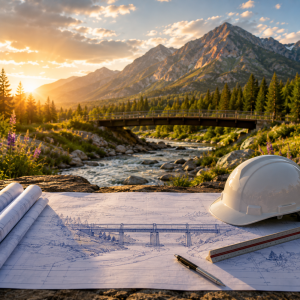
 Spend enough time outdoors in Utah, and you begin to notice something remarkable.
Rivers rarely flow in straight lines. Mountains distribute weight in ways that create incredible stability. Tree roots spread outward before they grow deeper. Even the smallest canyon has been shaped by thousands of years of persistence rather than a single dramatic event.
Nature has been solving engineering challenges for millions of years.
While civil engineering relies on science, mathematics, and modern technology, many of the principles that underpin successful infrastructure mirror systems found in the natural world.
At McNeil Engineering, we believe some of the best inspiration comes from simply observing how the world already works.
Water Always Finds a Path
One of the first lessons every civil engineer learns is to respect water.
Water follows gravity, adapts to obstacles, and eventually finds the most efficient route available. If infrastructure ignores that reality, water almost always wins.
That is why drainage design plays such a critical role in civil engineering. Stormwater systems, grading plans, retention basins, and culverts are all designed to guide water rather than fight against it.
The most successful projects work with natural drainage patterns whenever possible, rather than forcing entirely new ones.
Nature has been teaching that lesson for centuries.
Strong Foundations Are Usually Invisible
Walk through a forest, and you rarely notice what lies beneath your feet.
A tree’s strength is not determined by the branches everyone sees. It comes from an extensive root system hidden underground.
Engineering follows the same principle.
Roadways depend on properly prepared subgrades. Buildings rely on carefully designed foundations. Bridges transfer enormous loads through structural systems that remain largely invisible once construction is complete.
The strongest projects are often supported by the components that receive the least attention.
Flexibility Creates Durability
It is easy to assume that strength means rigidity.
Nature often demonstrates the opposite.
Trees bend in strong winds rather than resisting every force. Rivers adjust their course over time. Wetlands accommodate fluctuating water levels without compromising their purpose.
Modern engineering increasingly embraces this same mindset.
Infrastructure must withstand changing traffic volumes, evolving communities, and unpredictable weather conditions. Flexible design approaches often outperform rigid solutions because they allow systems to adapt rather than fail.
Long-term resilience depends on more than strength alone.
Small Systems Create Big Results
A single stream may seem insignificant.
Over time, however, thousands of small streams shape valleys, support ecosystems, and influence entire landscapes.
Engineering projects often work the same way.
One storm drain does not protect a city. One sidewalk does not improve walkability. One utility connection does not support a growing community.
But together, these smaller systems create infrastructure that functions efficiently as a whole.
Great engineering rarely depends on one dramatic feature. It depends on hundreds of interconnected decisions working together.
Planning Happens Long Before Growth
Nature prepares for tomorrow long before tomorrow arrives.
Trees produce root systems capable of supporting future growth. Rivers carve channels that can accommodate changing water levels. Ecosystems develop balance over decades.
Civil engineering follows a similar philosophy.
Roadways are designed with future traffic in mind. Utility corridors anticipate community expansion. Stormwater systems account for development that may not occur for years.
The best engineering decisions are often made long before the need becomes obvious.
Technology Helps Us Understand Nature Better
Today’s engineering tools allow us to study the natural environment with incredible precision.
Drone mapping, LiDAR scanning, advanced surveying equipment, and digital terrain modeling provide detailed information about landscapes before construction begins.
These technologies do not replace nature’s influence.
Instead, they help engineers better understand existing conditions, enabling projects to be designed with greater accuracy and less environmental disruption.
The more we understand the land, the better we can design for it.
Building With Respect for the Environment
Modern civil engineering is increasingly focused on balancing development with environmental stewardship.
Protecting waterways, preserving natural drainage patterns, minimizing erosion, and designing sustainable infrastructure all contribute to healthier communities.
Successful projects recognize that development and environmental responsibility are not competing priorities.
When approached thoughtfully, they strengthen one another.
Engineering Inspired by the World Around Us
Engineering is often viewed as a discipline built entirely on calculations and technical standards.
While those elements remain essential, some of the most valuable lessons come from observing systems that have already proven themselves over time.
Nature reminds us that resilience comes from preparation, flexibility, and thoughtful design. It demonstrates that strong foundations matter more than visible features and that lasting success is built one smart decision at a time.
At McNeil Engineering, those principles continue to shape how we approach every project. Because sometimes the world’s oldest engineer still has the best ideas.
