
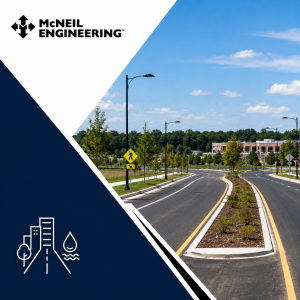
 When infrastructure is working properly, most people never think about it.
They drive to work without considering the roadway beneath them. They turn on a faucet without wondering how water arrived there. They visit parks, schools, businesses, and neighborhoods without thinking about the network of systems that make those places function every day.
Ironically, that is often the sign of great engineering.
At McNeil Engineering, we know that some of the most successful projects are the ones that blend seamlessly into everyday life. They perform so reliably that people rarely stop to think about the planning, design, and coordination required to make them work.
The Best Infrastructure Is Often Invisible
Many engineering projects are designed to solve problems before they ever become noticeable.
Stormwater systems prevent flooding during heavy rain events. Utility networks provide consistent service despite growing demand. Roadways accommodate traffic patterns that change throughout the day.
When these systems function properly, they disappear into the background. People simply go about their lives without interruption.
The challenge is that creating infrastructure that feels effortless requires a tremendous amount of effort behind the scenes.
Growth Creates New Challenges
Communities are constantly evolving.
New residential developments increase traffic volumes. Businesses create additional utility demands. Public spaces attract more visitors than originally anticipated. Population growth can place pressure on systems that were designed years earlier.
Civil engineers must think beyond current conditions and anticipate how communities will change over time.
A roadway that works perfectly today may struggle ten years from now if future growth is not considered during design. Utility systems that meet current demand may require upgrades if expansion is overlooked.
The best infrastructure is designed not just for today’s needs, but for tomorrow’s realities.
Small Decisions Have Large Consequences
Many of the most important engineering decisions seem relatively minor when viewed individually.
A drainage inlet may be moved a few feet. A utility alignment may be adjusted. A roadway entrance may be shifted slightly to improve visibility.
Each decision may appear insignificant on its own. Together, however, they influence safety, maintenance costs, traffic flow, accessibility, and long-term performance.
Engineering is often the process of making hundreds of small decisions that collectively create a better outcome.
Resilience Is Becoming More Important
Communities today face challenges that infrastructure systems did not always have to address.
Weather patterns are becoming less predictable. Development is occurring more rapidly in many regions. Aging infrastructure must continue performing while supporting new growth.
As a result, resilience has become a major focus within civil engineering.
Modern infrastructure is increasingly designed to withstand changing conditions while maintaining reliability. This includes improved stormwater management systems, more durable materials, and designs that provide flexibility for future expansion.
Building resilient infrastructure helps communities adapt while minimizing disruption.
Technology Is Improving Decision Making
Advances in technology are giving engineers more information than ever before.
Surveying tools provide highly accurate site data. Modeling software allows teams to evaluate multiple scenarios before construction begins. Drone technology offers detailed aerial perspectives that improve planning and coordination.
These tools do not replace engineering expertise. Instead, they provide better information that helps teams make smarter decisions.
The result is often greater efficiency, improved accuracy, and fewer surprises during construction.
Infrastructure Is an Investment in the Future
It is easy to view infrastructure as a cost because the work often occurs before visible development.
Roadways, utilities, drainage systems, and site improvements are typically among the earliest project investments. Yet these systems create the foundation that allows everything else to succeed.
Strong infrastructure supports economic growth, improves quality of life, and helps communities operate more efficiently. When designed properly, its value extends far beyond the initial construction phase.
The Engineering Behind Everyday Life
Most people will never see the calculations, plans, or coordination meetings that contribute to successful infrastructure projects.
What they will experience is reliable transportation, effective drainage, dependable utilities, and smoothly functioning communities. That experience is ultimately what engineering is about.
At McNeil Engineering, we are proud to help create infrastructure that supports growth, strengthens communities, and improves daily life. Even when nobody notices it, great engineering continues making a difference every single day.
